
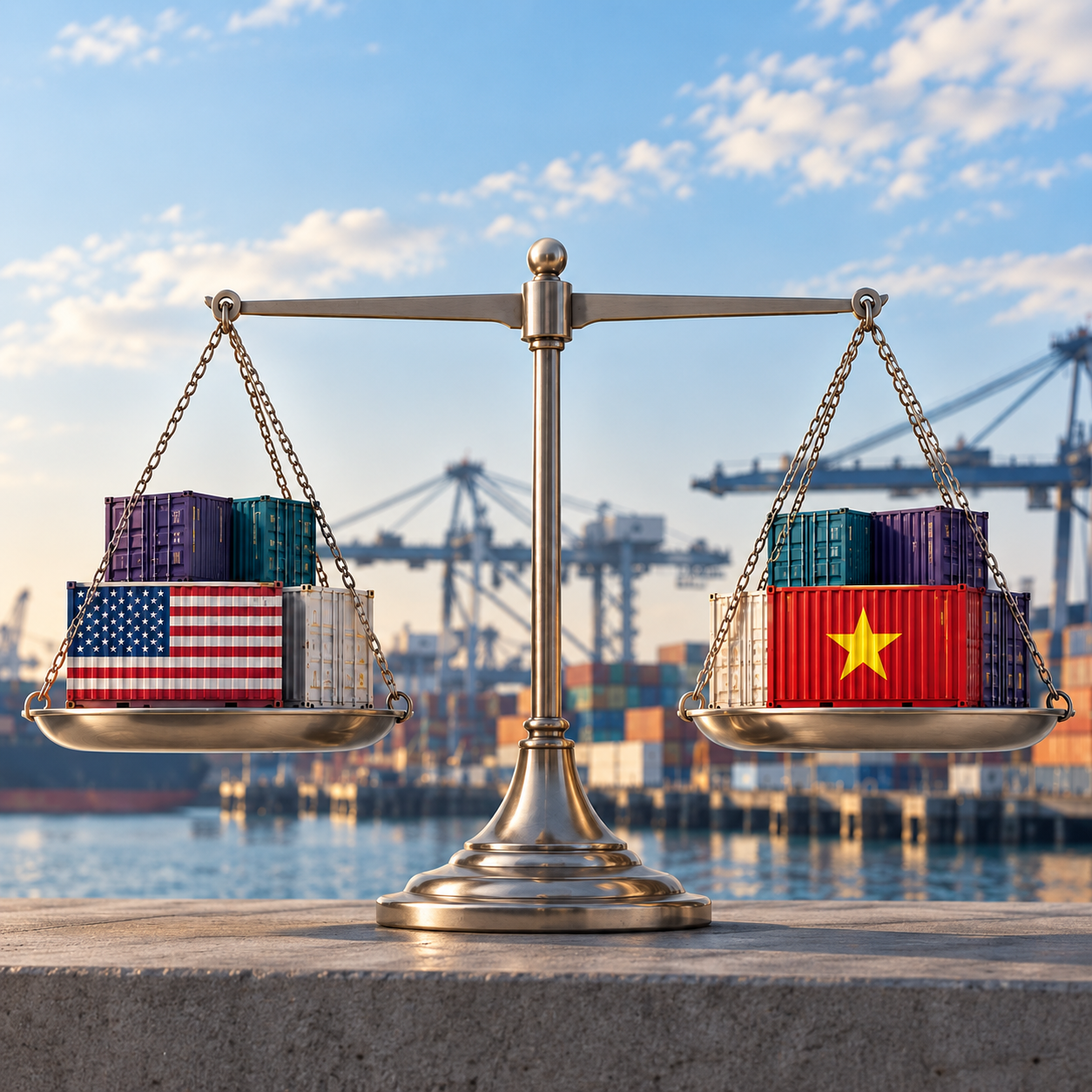
On April 30, 2026, USTR placed Vietnam in the Priority Foreign Country category, the harshest designation in its intellectual property (IP) toolkit. For Hanoi, the decision carries weight beyond IP policy. It comes at a moment when Vietnam is trying to sustain high growth and secure its place among the world’s largest economies. Washington had not used this label against any trading partner in 13 years. The last recipient was Ukraine, in 2013. Vietnam reached it in a single move, skipping past the intermediate Priority Watch List.
USTR based the designation on five complaints: piracy, counterfeiting, weak border enforcement, unlicensed software, and satellite signal theft. Washington first proposed an IP Work Plan to Vietnam in 2020, then a revised version in 2023. Vietnam, according to the report, made no meaningful progress on either, and the report ties that failure to “recent negotiations for an Agreement on Reciprocal, Fair, and Balanced Trade”.
The designation can become the gateway to a penalty. The Special 301 process allows the Trump administration to retaliate against governments it finds responsible for unreasonable or burdensome trade practices. On May 29, USTR opened a formal investigation into Vietnam on those grounds, using the same mechanism it relied on in 2017 and 2018 to justify tariffs of 7.5% to 25% on roughly $370 billion of Chinese goods, tariffs that remain in force today.
The question is whether Washington is using intellectual property as the formal trigger for a wider trade negotiation. Vietnam still has enforcement gaps, especially around deterrence and prosecution, but the timing, severity, and wording of the designation suggest that IP has become part of a broader bargaining strategy over tariffs, transshipment, market access, and alignment with U.S. trade priorities.
Is This a Missing Law Problem?
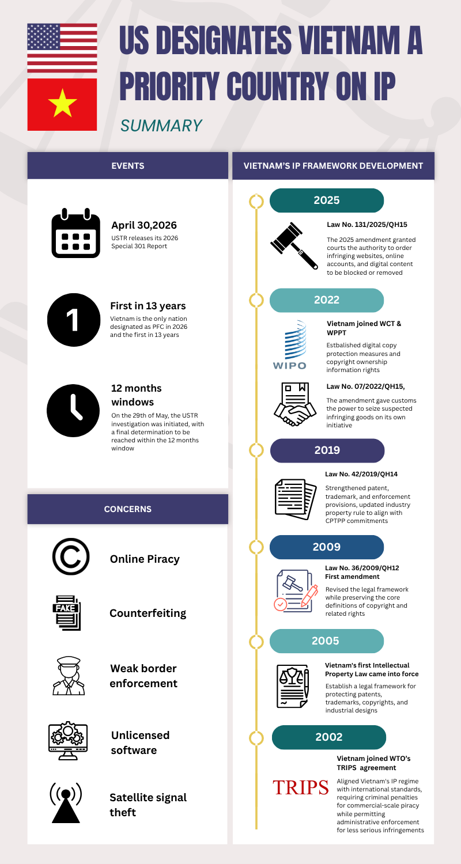
Vietnam’s 2005 IP Law has been amended four times since, in 2009, 2019, 2022, and 2025, each round timed to a new trade commitment. The 2022 amendment, the most sweeping of the four, met commitments Vietnam had already made under the CPTPP, the EVFTA, and the RCEP, four years before USTR’s report issued, and gave customs the power to seize suspected infringing goods on its own initiative. The 2025 amendment that followed gave courts a new power, the ability to order infringing websites, accounts, or content blocked or hidden outright.
None of that reads like a country short on legal tools. The piracy complaint, once you look past the statute, comes down to deterrence. Vietnamese authorities can find and shut down piracy sites. Vietnam-based host 2embed was shut down in 2023, and within the same network the domain MegaCloud simply took its place, feeding pirated video to more than 260 sites worldwide. What authorities haven’t done is make getting caught cost more than the crime pays. Fmovies, once one of the world’s most visited piracy sites, drew hundreds of millions of visits at its peak. When a Vietnamese court finally convicted its operators, it handed down suspended sentences and fines of $2,700 and $770, over the objection of prosecutors, a sum smaller than what the site likely spent on hosting in a single month. The WCT and WPPT that Vietnam joined in 2022 created the substantive rights against disabling copy protection or stripping ownership data from a work. How those rights get enforced is governed by a separate and older treaty. Vietnam has been a WTO member since 2007, bound by the TRIPS Agreement, which sets the global floor for IP enforcement. The TRIPS Agreement only requires criminal penalties for willful piracy on a commercial scale, and lets countries handle smaller infringement through administrative fines instead. Fmovies was commercial scale by any definition, though, and TRIPS specifically requires penalties ‘sufficient to provide a deterrent’ for cases like it. A suspended sentence and a fine smaller than a month of hosting costs falls short of that standard.
Of more than 3,300 IP-related cases Vietnamese authorities logged through mid-July 2026, only 85 ended in criminal prosecution, a rate under 3%. Vietnam’s Vice Minister of Science and Technology, Hoang Minh, said as much at a government review meeting in June, that some IP offenses remain loosely defined in the Criminal Code and that penalties for several offenses fall short of effective deterrence. The Ministry of Public Security has since been tasked with drafting an amendment to the Criminal Code itself to raise penalties and clarify prosecution standards.
Although Vietnam’s legal framework still leaves room for improvement, the challenge lies less in the statutes themselves than in enforcement behavior. On that front, Vietnam’s response since early 2026 has been more aggressive than the designation alone might suggest, though results remain uneven.
The Crackdown
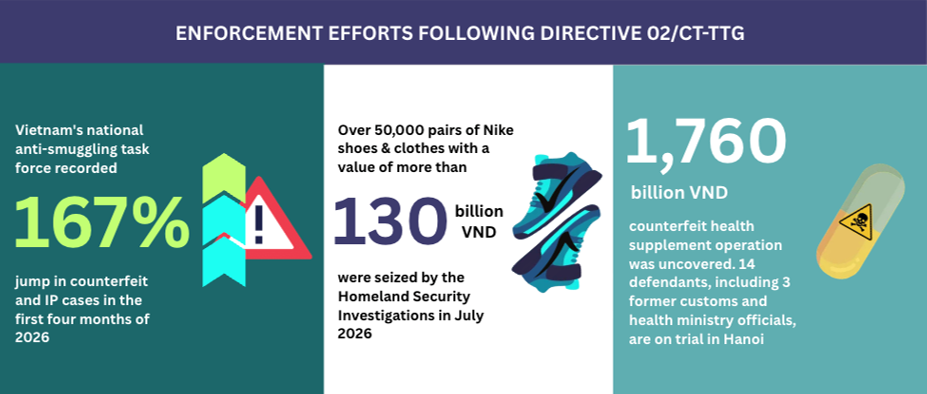
Three months before the report, the Prime Minister issued Directive 02/CT-TTg on January 30, ordering coordinated IP enforcement across ministries as part of a five-year national action plan approved the previous December. Vietnam’s national anti-smuggling task force recorded a 167% jump in counterfeit and IP cases in the first four months of 2026.
After the designation, Vietnam moved with even more urgency. Prime Ministerial Official Telegram 38, issued May 5, ordered enforcement agencies nationwide to act with no exempted zones or exceptions and set a 20% increase in cases handled as the benchmark for every province. The numbers climbed quickly: 1,438 cases by May 27, 2,036 by May 30, and more than 3,300 by mid-July. Enforcement also became more visible in the entertainment sector. Seven people, including the CEOs of BH Media and Lululola Entertainment, were charged in May over unauthorized reposting of music performances, while Xoilac TV, a piracy site USTR named directly, was taken down along with 18 others.
The border complaint also produced genuine cross-border cooperation. Acting on a tip from U.S. Homeland Security Investigations, market surveillance authorities raided a Ho Chi Minh City workshop in July and seized nearly 50,000 pairs of counterfeit Nike and Air Jordan shoes worth more than 100 billion dong, some already shipped to the U.S. under forged Nike authorization documents. A second raid in Binh Duong days later turned up another 35.6 billion dong worth of counterfeit Nike clothing. Separately, customs seized counterfeit Adidas, and Samsung products moving in transit toward Cambodia through a crossing in Dong Nai province in May, the category of shipment USTR’s report says Vietnamese law gives customs no authority to touch. Courts have prosecuted seriously too. Fourteen defendants, including three former customs and health ministry officials, are on trial in Hanoi over a counterfeit health supplement operation worth more than 1,760 billion dong, the public health risk USTR’s report names by name.
The enforcement push shows the government’s commitment to cracking down on copyright infringements. Nonetheless it does not adequately address the USTR’s charges, at least, yet. The prosecution rate has not visibly moved since June. Article 4 of Vietnam’s IP Law still has no matching Criminal Code penalty for signal theft, in either the 2022 or 2025 amendment. A different structural problem runs through Vietnam’s music sector. Vietnamese law splits related rights across three categories, covering performers, record producers, and broadcasters. A single song multiplies that structure further: composers and lyricists typically hold separate authorship claims, while distribution rights add another layer. No unified national copyright database exists to sort out who owns what. No published fee schedule tells a business what a license should cost. A company trying to comply in good faith often has no way to find out who to pay.
Vietnam could still write stronger deterrent measures into its own laws and enforce them harder. But given how consistently Vietnam has updated its laws to address IP concerns, the severity of the PFC designation raises a proportionality question. USTR’s 2026 report names India and Vietnam side by side as countries with “high levels of online piracy” and a lack of effective enforcement. India remained one tier lower, on the Priority Watch List, while Vietnam alone was moved to the harshest category.
That proportionality question is where the IP story starts to become a trade story. The designation did not happen in isolation. It arrived during a broader U.S. effort to renegotiate trade relationships with surplus countries and to pressure partners seen as possible channels for China-linked exports.
The Trade Deal Underneath
The Trump administration’s “America First” trade policy treats a large bilateral deficit as evidence of unfair trade in itself, regardless of what drives it. Since 2025, Washington has been signing Agreements on Reciprocal Trade with countries running large surpluses with the U.S. Under these deals, a country makes market-opening concessions and aligns its economic security measures with U.S. actions against China in exchange for a lower tariff rate than it would otherwise face. Argentina, Bangladesh, Cambodia, Ecuador, El Salvador, Guatemala, Indonesia, Malaysia, and Taiwan have all signed one. Vietnam has not, despite a U.S. delegation traveling to Hanoi in May 2026 specifically to push the issue. India has not either. But only Vietnam’s PFC designation ties the failure to that stalled negotiation, in USTR’s own words.
Vietnam’s trade deficit with the U.S. hit $178 billion for calendar year 2025, then kept climbing. Over the 12 months ending in April 2026, the U.S. ran a bigger merchandise deficit with Vietnam than with Mexico for the first time ever. By May, the rolling total stood at $204 billion for Vietnam against $199 billion for Mexico, with Taiwan a few billion behind and closing fast. The U.S. imports 12.4 dollars of goods from Vietnam for every dollar it exports there, compared with 1.58 for Mexico and 1.14 for Canada, a ratio that reflects one-directional sourcing rather than the integrated, two-way production chains the U.S. has with its North American neighbors. Mexico and Canada sell back close to what they buy because their factories are wired into U.S. supply chains. Vietnam’s trade runs almost entirely one way.
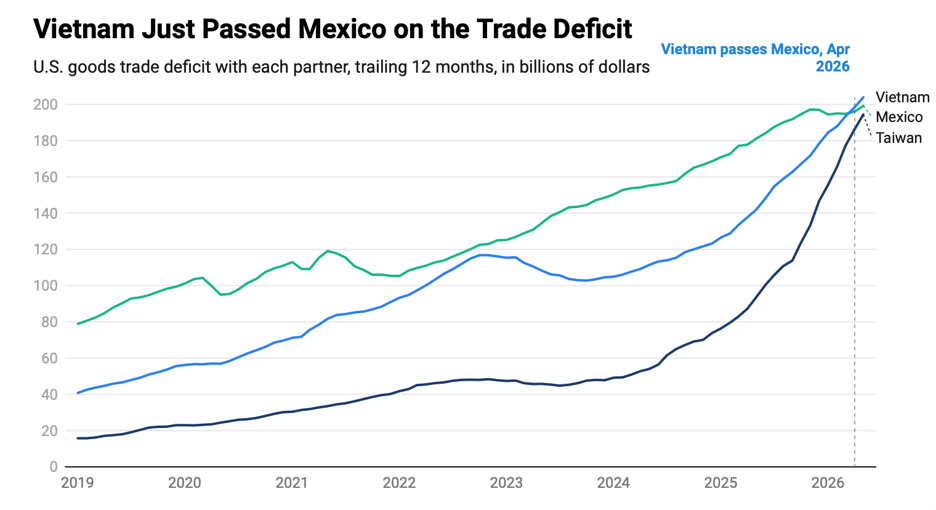
Source: U.S Census Bureau
Trump’s trade adviser, Peter Navarro, made an accusation about that imbalance on Fox News in 2025. “Vietnam sells us $15 for every $1 that we sell them”, he said, “and about $5 of that is just Chinese product that comes into Vietnam, they slap a Made in Vietnam label on it and they send it here to evade the tariffs”. A 2025 trade deal turned that suspicion into policy, a 40% tariff on goods deemed ‘transshipped’ through Vietnam, double the standard 20% rate, though the administration has never defined the term precisely according to Reuters. U.S. customs inspected China-linked factories in Vietnam as recently as this week, without yet producing evidence of large-scale rerouting.
In terms of the trade numbers, much of the growth is American and South Korean companies, Apple, Intel, Samsung, relocating actual production to Vietnam, not funneling Chinese goods through it. But the sheer size of the one-way flow still leaves Vietnam without leverage. Unlike Japan, South Korea, Taiwan, or the EU, it has no comparable pledge of U.S. investment to offer in exchange for a lower tariff. Vietnam has still offered concessions of its own. It cut its ethanol import tariff from 10% to 5% in 2025 to buy more from American producers, and the U.S. was already Vietnam’s largest ethanol supplier that year. A nationwide mandate requiring gasoline to carry 10% ethanol content took effect in 2026, a policy Vietnam’s own biofuel industry has openly described as part of the broader trade package with the U.S. Vietnamese airlines signed more than $30 billion in aircraft and engine deals with Boeing and Pratt & Whitney in early 2026 alone, and state energy company PV GAS committed $1.3 billion to an LNG import terminal with the American firm AES. Hanoi is also negotiating with Lockheed Martin over military transport aircraft, in exchange for removal from a U.S. high-tech export restriction list and recognition as a market economy.
Vietnam has also set a target of 10% annual GDP growth for 2026 through 2030, part of a broader ambition to become an upper-middle-income economy among the world’s 30 largest by decade’s end, giving it more reason than most trading partners to reach a trade deal with Washington quickly.
FocusEconomics estimates the forced labor case alone could push Vietnam’s effective tariff rate on U.S.-bound exports from 16.7% to 21.2%, the highest tier among 60 economies reviewed, above Bangladesh, Cambodia, Indonesia, and Malaysia, each at 10% because they’d already signed trade deals Vietnam hasn’t. Whatever comes out of the IP investigation, due under Section 301’s 12-month deadline by next May, would add to that total and push the rate higher still. Textiles and footwear, industries with a combined production value above 65 billion dollars, would likely carry much of the weight. An earlier round of tariffs in 2025 already cut footwear exports by 27% and apparel by 20% in just two months, a sign of how exposed these sectors are. Electronics, Vietnam’s biggest export category, may fare better, since goods already covered by Section 232 national security tariffs are exempted from this particular measure, though how much of Vietnam’s electronics trade that actually covers isn’t confirmed.
In 2020, USTR opened a Section 301 investigation into Vietnam’s currency practices, alleging undervaluation of up to 8.4%, timed to a bilateral deficit that had just become one of the largest in the world. On his last full day in office, President Trump’s USTR found the currency practices “unreasonable” but took no retaliatory action. The case did not simply disappear. In July 2021, it closed through a negotiated agreement in which Vietnam’s central bank committed to specific currency management reforms, and USTR issued a formal determination of satisfactory resolution. No tariffs were ever imposed. If the IP case follows the same path, the endpoint looks like a signed agreement, not a tariff, one that lets Washington claim stronger IP enforcement while giving Hanoi a way to reduce its tariff risk.
By Giang Khu
Senior Policy Consultant, Pioneer Consulting